
Revenues from 3G and Broadband Wireless Access spectrum auction has helped government reduce the deficit.

Lower crude prices mean less government outlay for India,

The recommendations will benefit 47 lakh central government employees and 52 lakh pensioners.

Investors should view the increase in the LTCG tax rate in conjunction with the increase in capital gains exemption from Rs 1 lakh to Rs 1.25 lakh, which will provide some relief.
The Centre's fiscal deficit fell by 42 per cent to Rs 90,915 crore (Rs 909.15 billion) during April-July, 2010, year-on-year, on increased revenue receipts from the auction of 3G spectrum.

For 2017-18, the government aims to bring down the fiscal deficit to 3.2 per cent of the GDP. Last fiscal, it had met the 3.5 per cent target.
Citigroup revised CAD estimates for financial year 2013 to 4.7 per cent from 4 per cent of GDP after incorporating the latest trade and GDP data, and said CAD is likely to stay elevated in financial year 2014 as well.
The strategy to achieve the target would be to maximise revenue collections and control expenditure, Chidambaram said, while seeking support of the political parties to deal with economic and financial problems facing the country.
High current account deficit, however, remains a major concern.

Fresh plans of privatisation or divestment in central public sector enterprises and public sector banks might take a back seat this financial year because these may require a large consensus among coalition partners.

The gap between expenditure and receipts totalled Rs 3.98 crore (Rs 39 million) over the April 1-August 31 period against the Rs 5.31 lakh crore(Rs 5.31 trillion) pegged in the Budget for 2014-15.
The Reserve Bank (RBI) resisted a 'raid' planned by some in the government to extract Rs 2-3 lakh crore from its balance sheet in 2018 to meet populist spending in run-up to general elections, Viral Acharya, who was deputy governor at RBI at that time, has written.

With the prediction of an above normal monsoon in 2024, the government is expecting food prices to come down, the finance ministry's monthly economic report for March has said. The report, released on Thursday, said robust foreign inflows and comfortable trade deficits were expected to keep the rupee within a comfortable range. "Further easing of food prices is on the anvil as IMD (India Meteorological Department) has predicted above-normal rainfall during the monsoon season, which is likely to lead to higher production, assuming good spatial and temporal distribution of the rainfall," the monthly report, released by the Department of Economic Affairs, said.
In the corresponding period of the last financial year, fiscal deficit was 39.4 per cent of the estimates.

>According to the latest RBI data, PPF receipts have already experienced a decline between April 2023 and February 2024. Other schemes like the Sukanya Samriddhi Account and National Savings Certificate are also witnessing reduced inflows.

The RBI needs to maintain a healthy contingency reserve so that it can lend its support in case of a bank failure.

While the April-February deficit is pegged at 5.3 per cent of GDP, the final print may be a tad lower due to revenue push and expenditure cuts seen in March, the last month of 2013-14 fiscal year, it said.
Many ministries couldn't use the allocated funds since it came into force, resulting in much-needed savings.

While SGBs are a sound investment, they aren't worth buying at any price. The interest income you earn from them will not justify paying a high premium.
The report noted that export volumes are likely to remain sluggish.
The Indian Railways is set to record a marginal surplus in the current financial year -- much lower than the Rs 5,258 crore (Rs 52.58 billion) budgeted in February 2011. But, the fall is only a trailer, considering the country's largest passenger and goods transport network is likely to go into deficit next year.

Country's fiscal deficit touched Rs 516,390 crore or 95.2 per cent of the annual target during April-December, the Controller General of Accounts said.
The central government's fiscal deficit climbed to Rs 81,014 crore (Rs 810.14 billion) for the first six months of the financial year 2003-04.

'There is also a possibility that Andhra Pradesh may demand a similar package. But as of now, we are only working on a package for Bihar.'

There hasn't been any dramatic moment in the first act (the Budget) but nobody would complain. It's par for the course as long as the figures don't change in the main Budget, which will be presented after general elections.
The external current account deficit remains our biggest worry today.

In 2019-20, the capital expenditure of Indian Railways (IR) increased 60 per cent over 2016-17. The draft National Railways plan envisages a further increase in IR's capital expenditure, but an analysis by Business Standard shows that IR has come to depend more on borrowings and budgetary support. In 2016-17, while 11 per cent of its capital expenditure (capex) was funded by internal sources, in 2019-20 the ratio dropped to less than 1 per cent. A 2015 Committee on Restructuring Railways had flagged that over-reliance on borrowings could exacerbate the financial situation of Railways.
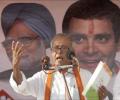
Finance Minister Pranab Mukherjee on Tuesday said the government has taken the calculated risk of high fiscal deficit to help stimulate growth, but would strive hard to bring it down to 4 per cent in the next two fiscals.

The government on May 17 formed a five-member committee.

PowerGrid was the top gainer in the Sensex pack, spurting 2.76 per cent, followed by NTPC, M&M, L&T, Hindustan Unilever, HDFC, and Infosys.
India plans to keep its fiscal deficit within 3.9% of GDP.

India's fiscal deficit soared by 34 per cent to Rs 3.5 lakh crore in the first ten months of the financial year against Rs 2.62 lakh crore a year ago, mainly on account of the stimulus measures taken by the government to prop up the economy hit by the global financial crisis.

The Centre's fiscal deficit narrowed by 39.08 per cent year-on-year to Rs 1.86 lakh crore (Rs 1.86 trillion) in April-November, 2010, on the back of better-than-expected revenue from the sale of spectrum and robust tax collections.

The finance ministry expects a broad-based moderation in inflationary pressures on the back of an anticipated reduction in food prices as a result of the uptick in summer sowing. The retail inflation rate remained stubbornly clung to the 5 per cent mark in seven of the past eight months. "Core inflation is trending downwards, indicating a broad-based moderation in price pressures... Driven by strong domestic growth and benign global commodity prices, core inflation is declining continuously.
Finance ministry tells PM fiscal deficit target will be met, capex expenditure won't be cut and GDP growth will surpass 7.5%.
While euphoria over the Iran deal has waned sharply, the current account deficit has gone into remission due to a collapse in gold demand.

Three years after India declared its goal to become a net-zero economy by 2070, the policy design for achieving the target has begun, with the NITI Aayog forming dedicated multi-sectoral committees to prepare a transition plan. In 2021, India joined a select group of nations that set a target year for becoming net-zero carbon economy. At COP26 in Glasgow, Prime Minister Narendra Modi outlined a five-pronged 'Panchamitra' climate action target for India and committed to a net-zero target by 2070, joining nations like the US, the UK, and China.

The deficit represents 39.7 per cent of the estimate for the current financial year.

The banking system liquidity bounced back to surplus mode after three weeks, the Reserve Bank of India (RBI) data showed. This was due to government spending, according to dealers. The liquidity situation could further ease with the disbursement of the last tranche of incremental cash reserve ratio (I-CRR) worth Rs 50,000 crore on Saturday.

Non-Plan expenditure for April-May stood at Rs 2.01 lakh crore.
